Summer Claims Chaos
Here in the North East of the US we have had a rather stuttering Spring, but soon we will be headed into Summer and for claims departments that means doing more with less. The claim volumes tend to increase over the summer months (and why not the weather is gorgeous!!) and claim managers want vacation too.
In the STD area, running an effective claim segmentation program can make the heat of the summer survivable. Let me explain how this works.
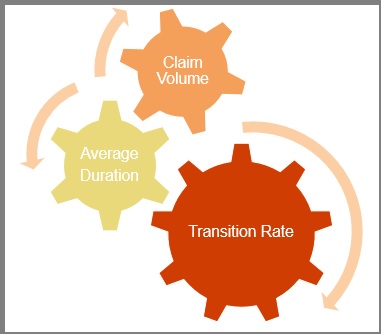
Using analytics we can see that claims operations are very sensitive to increases in claim volume. If this is measured by the number of claims that a claim manager has allocated to them (case load by claim manager). As this number increases, the quality of claim management reduces.
“Fine but how are you measuring this?” I hear you ask.
Well, typically we see claim shops being very hot on the easy metrics like average wait time to approval, or time to make the first payment, etc as these are measures that we have promised to our clients, our service levels if you like.
But it’s not these we look at, as typically these are not affected by increases in claim volume. Instead we look at the transition rate to LTD, as this is the real victim of increases in volume.
What we see here, and it’s not rocket science, is that as claim mangers get busy, they have less time to do those chase-ups, those call-backs, the check-in calls…. These items in the workflow queue get left to run.
This causes an increase in the transition rate, as more STD claims reach their maximum and move into LTD.
This is very expensive, as soon as a claim transitions to LTD the cost of that claim leaps up, this is especially concerning if it happens to be a claim that should have been resolved within the STD period.
However, I’m sure that you are familiar with this dynamic!
So what can we do to help?
We have developed a ‘fast track’ approach that enables you to change the threshold of entry to this process, depending on your claim volume.
We use a predictive model to project the duration of a claim and from this we select claims that are appropriate for the fast track process.
This process is designed for those claims which do not need management for return to work. So the majority of maternity claims would meet this criteria, and injury claims, as well as low risk profiles of claims in higher risk categories, which the model has selected.
So for example a computer programmer with a broken leg, who has a 90 day STD contract, is likely to return to work well within their contractual period, and has a very low risk of transition. The model quantifies all these data points and many more to assess the risk of fast track for each claim.
The risks are that you pay the claim for too long, and end up in an overpayment situation, or that you pay the claim for not long enough and the claim is re-opened, an ‘underpayment’.
In reality the former is the bigger of these problems as you may not even find out about it, or if you do, getting the money back can take time. However, this is balanced by the under payment factor. An underpayment situation can put a little more pressure on an employee to return to work. For example, if an employee is paid until the end of the week, but still does not feeling too good, then they may have taken more time off work if the claim was still open. However, if to do this they have to contact the insurance company and go back to their doctor, they may just decide to go back to work anyway.
So here we have the essence of claim segmentation with the fast track approach used to save the claim managers time to spend on the difficult claims, with the predictive model balancing the risk criteria.
‘But how does this help me in the Summer?’
By adjusting the model, we can increase the number of claims that go through the fast track process, so as claim volumes increase, with no more claim management resource available, you can ‘turn-up’ the volume of claims that go through this expedited process. This will slightly increase the risk of over and under payments, but will leave claim mangers with time to manage the most resource hungry segment, those claims that are at high risk of transitioning to LTD, even though volumes have gone up.
“But how do I do this?” I hear you say…
Please contact The Claim Lab and we will take you through the detail: info@claimlab.org